Wednesday, October 21, 2009

"World's Women For Life"'s report on first mission to Southern Kurdistan on air

This videos are in three parts prepared from an interview with Soraya Fallah president of WWFL.
Mr. Nyma Ardalan in Swana Collection did the interview for KPFK 90.7. This interview is regarding an Internationational conference on Culture of life on Aug 2009 in Southern Kurdistan.


Sunday, October 11, 2009

Mourning Mothers of Human Rights Activists Worldwide


WUNRN
 
Women News Network
 
October 8, 2009

'Mourning Mothers Iran' Stand with Human Rights Activist Mothers Worldwide

Elahe Amani with Lys Anzia – Women News Network – WNN

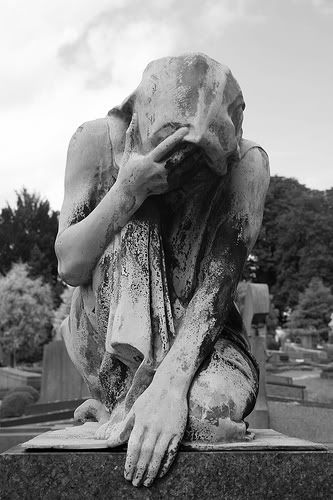
Weeping woman statue. Image: Luc De Leeuw 2009

Weeping woman statue. Image: Luc De Leeuw 2009

A mother protecting her child isn't anything unique. But in Iran, humanitarian activist mothers are now becoming global icons for human rights causes worldwide. In silent public protest, the 'Mourning Mothers of Iran,' known locally in Tehran as the 'Mothers of Laleh,' stand together each week, on Saturday evening vigils in Tehran's Laleh Park.

"I urge all women around the world to show their solidarity with the Committee of Iranian Mothers in Mourning by assembling in parks, in their respective countries, every Saturday between the hours of 7 to 8 p.m., wearing black," said Nobel Peace Prize Laureate, Shirin Ebadi, in a plea made to women and activists worldwide at a July 25 Iran pro-democracy rally in Amsterdam. Like the infamous "Women in Black," and the 'Madres de Plaza de Mayo,' the Committee of Iranian Mothers use methods of ethics in non-violence to bring attention to the atrocity of their dead children.

Beginning in Jerusalem, in 1988, a group of almost 40 Israeli-Jewish women of conscience formed 'The Women in Black.' To make their point, they wore black clothing and stood silent in public protests. They protested against Israeli expansion into the West Bank and Gaza on the heels of the beginning of the 1987 Palestinian intifada. Soon Arab women from the northern region of Israel also joined the Women in Black. The message was asked for "Peace!" Opposing war, injustice, and militarism, Women in Black groups and their affiliates can also be found in Iran, Australia, the UK, Serbia, Japan, South Africa, Italy, Spain, the Netherlands, Belgium, Canada, US, India, Nepal, Uruguay, Argentina and the Philippines, to name a few.

Outside of Jerusalem, 1988 was also a very dark period for Iranian history. In a few summer months, an enormity of crimes against humanity occurred as an overwhelming number of Iranian political prisoners were massacred. This left thousands of Iranian mothers devastated.

According to reports from Amnesty International, 4,500-10,000 Iranian political prisoners were declared killed or missing inside the country that year, over a period that lasted barely two months. After finding out about the death of their loved ones, the families of the victims were not allowed to receive the bodies of their dead. They were also not allowed to hold any funerals. Instead, the held bodies were dumped together in places like Khavaran or what the regime referred to as La'nat-Abad, 'The Damned Place,' a cemetery used for burying non-Muslims.

Mass burials at Khavaran were later accidentally discovered by an Armenian priest who had become curious as to why stray dogs kept digging for bones at, what was later determined the location of the mass graves. French-Iranian woman filmmaker, Mehrnoushe Solouki, was held in Evin Prison for nine months as she, too, stumbled on the discovery in 2007. 

"The deliberate and systematic manner in which these extrajudicial executions took place may constitute a crime against humanity under international law," said Human Rights Watch, in 2005. Perhaps of all the crimes against humanity in the last 30 years, the 1988 Iranian mass executions continue to be the most revealing indication of the regime's contempt and fear of political dissidents.

"In the recent events, the government in Iran has been fabricating reports depicting an incorrect image of what has been going on in the country," said Ebadi at the July 25, 2009 rally. "They do not want the people to know the truth."

We may think this kind of protest is new in Iran, but Iranian mothers have always spoken out against violence, disappearance and the torture of their sons and daughters. Prior to the 1979 revolution, only two mothers' organizations existed in the country. Both were affiliated with underground groups involved in struggles for democracy. They worked in opposition to the monarchy of the Shah's regime, who's policies had turned, at the end, to the jailing and torture of intellectuals, feminists, students, and labour union advocates.

"I need to tell my story. No one can stop me. No one!" said Parvin Fahimi, an active member of Mothers for Peace and the mother of slain 19 year old Iranian protester, Sohrab Arabi, said recently in July. "My son had been killed, but they refused to tell me," she continued.

Mothers of Plaza de Mayo

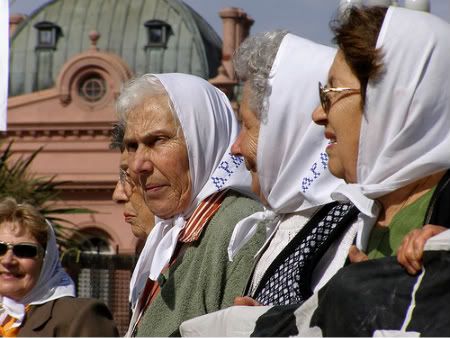
Madres de Plaza de Mayo - Buenos Aires, Argentina, 2008.

On July 11, 2009, young Sohrab Arabi was identified as 'Picture Number 12′ by his older brother at the Shapour Street Police Station in Tehran. He was dead and his family finally knew the truth. He had been missing for 26 days. On the realization, his mother was beside herself with grief.

"Please hear my painful story as a resident of Tehran. I lost my son on Monday 25 of Khordad (15 June) during a peaceful rally that was taking place to protest the election results. With the crowds estimated at a minimum of 3 million, many people were lost and I too lost my son. The mobiles were cut off and I couldn't reach him – I searched everywhere for him and went back home and found he was not there either so I went back to Azadi Square to keep searching for him. The atmosphere was terrible, so much tear gas everywhere, it felt more like a battle ground and I have been sick ever since with chest problems. I couldn't find my child and I returned home and together with the sons of my relatives. As we searched every hospital and police station we didn't get a response. My son did not have his ID card with him; he just had a bit of money on him to go and buy test papers at Enghelab Sqaure to prepare for the university entrance exams coming up…

That night I still did not hear of my son. The next morning when I called 110 (the emergency police call number) they told me to refer to my local police station. I went to the local police station and filed a missing persons report and they started the search process. No one had the guts to tell me than that maybe my son was killed; some people said he was probably arrested and some said he may be injured. I found out that 7 people were killed that day (at the protests) of those, 5 had been identified and 2 had not. The 2 that had not been identified were apparently older. The sons of my family members went to see the 5 that were identified and they confirmed that none of them was Sohrab. I was relieved to hear that and thought that my son was therefore arrested. I knew that he wasn't injured because I searched every single hospital. I am aware that some hospitals would not give me a clear answer, but others did.

So I headed out for the Revolutionary Court (Evin Prison) to follow up on his arrest. They told me to return home and I told them I couldn't – I am a Mother – I couldn't even eat. To this date I have a hard time eating. My throat just closes up. I have kept myself going through liquids only in the past few weeks. I can't tell you how much time I spent at the Revolutionary Court… if I were to write the story it'd make a very thick book. . .

How can a 19 year old that has yet to sit at the University entrance exams, and has yet to fulfill any one of his dreams, be killed? By whom; and on whose orders; and for what? I ask the City Council, what did my son ask of you? What did he ever ask of the government? What did he ask of his country? …We wanted nothing but peace, tranquility and a freedom of thought – that's what's important to us, is that my son thought about whom he voted for and where his vote goes. He didn't ask for anything else. Just because he was a supporter of Mr. Mousavi, he must be killed? For what crime? On the basis of what guilt? My son was in the prime of his youth, a 19 year old, who never fulfilled his dreams. As a mother, I ask God day and night to put an end to this injustice."

- Parvin Fahimi, mother of slain protester, Sohrab Arabi
(Partial testimony given during a Tehran City Council
meeting July 23, 2009)

The exact circumstance surrounding the death of Sohrab Arabi continues to be unexplained. According to the International Campaign for Human Rights Iran, when the family received Arabi's body, his death appeared to be from the result of a gunshot wound to the chest, but no one knows when or where this injury occurred. An official, but inconclusive, report was made by the Coroner on June 19.

The lives of the mothers of missing global activists, who are often called, 'mothers of the disappeared,' are often filled with moments of endurance and courage, in spite of the grief they carry. From the mothers of slain reporters working in Iraqi Kurdistan or the Ukraine; to the mothers of missing activist children in Iran or Argentina; the mothers of those who have who have 'gone missing' have the same experience over and over again. Mothers worldwide have the same fear, grief, anger and frustration about their dead and missing children.

"I begged the gunmen to kill me instead, and they pushed me away and told me that they wanted her not me," said Kurdish mother of slain Iraqi journalist, Sara Abdul-Wahab, during a May 2008 Associated Press interview. In spite of her mother's attempt to save her life, Sarwa was fatally shot twice in the head by kidnappers. Tragically, her mother felt she could do nothing to save her daughter. Sarwa was the only breadwinner for a widowed mother, a sister and brother. She was a strong defender of human rights, a Kurdish lawyer and activist in Iraq, who continued to work in spite of numerous threats against her life.

When Ukrainian Prosecutor, General Mykhaylo Potebenko, issued a statement saying that DNA tests were delayed due to the illness of Lesya Gongadze, the mother of the missing and presumed dead human rights reporter Georgy Gongadze, Leyla grew suspicious. "This is a complete lie and deception," she told Ukrainska Pravda, the Web newspaper that her son founded. "I wasn't that sick, not so much as to be unable to give my blood for analysis. I was even insisting on it because I wanted to know the truth," she added.

For nine year Gongadze case has been rife with confusing facts and government shuffle. Georgy Gogandze's mother, Lesya Gongadze has been struggling to expose the facts from the moment her son went missing. Faced with the dilemma of not trusting the validity of DNA tests made by the Ukrainian authorities for an unidentifiable body that was found in 2000, Lesya continues to ask questions and demand clarity on the true circumstances surrounding the murder of her son. To date, she has not been satisfied with the answers given her.

In Argentina, mothers of missing activists ask the same questions as mothers worldwide. These questions have lasted in Argentina almost 33 years. In 1977, they came together in Buenos Aries calling themselves the 'Madres de Plaze de Mayo (Mothers of the Plaza de Mayo).' Ignoring a law prohibiting more than 3 people from gathering in one place, they began walking the plaza two by two, in the form of heroines under the threat of arrest. They began as 14 mothers who publically protested the disappearance of their children. Their protests began during what has been called the 'Dirty War' of Argentina, a war beginning with the military dictatorship of General Jorge Rafael Videla.

"By the end of the year (1977), thousands would be illegally detained, tortured, assassinated or disappeared," says a now declassified document at the US National Security Archive.

In panic under the sudden disappearances of Argentine labour advocates, students and social activists, the mothers began to speak out strongly to demand answers. A military coup had taken over Argentina with a vengeance, lasting seven long years with what has been counted today as up to 30,000 missing or dead.

In 1978, "A recent dramatic occurrence was the abduction, in December, of five 'mothers of the disappeared' and two French nuns, whose bodies were reportedly discovered washed ashore," continues the declassified US National Security Archive report.

"One of the things that I simply will not do now is shut up. The women of my generation in Latin America have been taught that the man is always in charge and the woman is silent even in the face of injustice… Now I know that we have to speak out about the injustices publicly. If not, we are accomplices. I am going to denounce them publicly without fear. This is what I learned," says Mother of Plaza de Mayo, María del Rosario de Cerruti.

Since 1977, the bereaved mothers have gathered to walk around the Plaza de Mayo in central Buenos Aires for 30 minutes every Thursday afternoon. Wearing white headscarves as a symbol of peace, the simple action of the mothers walking in a circle for peace has finally caught the world's attention. Their movement has inspired families of the disappeared and victims of human rights violations in many parts around the world to engage in similar peaceful protests in public places.

On June 27, the Mothers of Lelah made a formal statement to the world that echoed the grief of all mothers worldwide.

"What crime have they committed to deserve death? Why do we Iranian mothers have to bear this enormous grief? What is our crime? We will never let this crime against us and our children pass by unnoticed. From now until the release of all detained demonstrators, the cessation of violence and until our children's killers receive their punishment, we will every week gather in silent mourning near the place where our beloved martyr Neda died at Park Laleh. We urge all parents who are concerned about their daughters and sons, the future capital of our country to join us."

- The Committee of Mothers Iran (Mourning Mothers of Laleh) 2009

To date, the Argentine mothers have received 3 major international awards for their work with human rights; the Sakharov Prize for Freedom of Thought, the United Nations Prize for Peace Education and the United Nations Prize in the Field of Human Rights. It is expected that the Committee of Mothers Iran (The Mourning Mothers of Laleh) will follow the legacy of Madres de Plaza de Mayo with special award and recognition in their time.

"Holding on to memory is the way to fight the remains of the past regimes who want the whole story of the disappeared to vanish," said Morea, one of the Plaza de Mayo mothers.

"If you want justice and freedom, you have to put everything else on hold," said Iranian mother Parvin Fahimi, recently in a Sept 2009 interview.

_________________________________________________________

Click Website Link & Scroll Down to Video:http://womennewsnetwork.net:80/2009/10/08/mourning-mothers-iran-stand-with-activist-mothers-worldwide/

This subtitled (English) video shows the depth of funeral grief of Parvin Fahimi, the mother of slain 19 year old Iranian protester, Sohrab Arabi, as she speaks out against the murder of her son.
_____________________________________________________________

Click Website Link & Scroll Down to Video:http://womennewsnetwork.net:80/2009/10/08/mourning-mothers-iran-stand-with-activist-mothers-worldwide/

Rock star, Bono, from the infamous band U2, brings the Mothers of Plaza de Mayo on stage during a concert in Santiago, Chile (1998) to address the audience one by one as they share their pleas for justice.
_________________________________________________________


================================================================
To contact the list administrator, or to leave the list, send an email to: wunrn_listserve-request@lists.wunrn.com. Thank you.

Wednesday, September 23, 2009

Cklara Moradina along with other prominent speakers in New York front of UN aganist Ahmadinejad


Solidarity committee for Advancement of Democracy in Iran (SCADI) چاپ ارسال به دوست
vokradio.com,Los Angeles, CA, USA
Protest Rally against Ahmadinejad at the United Nations
September 23, 2009

Solidarity committee for Advancement of Democracy in Iran(scadi_logo.jpgSCADI)

SCADI's program starts at 12:30 PM on September 23rd. SCADI will have a tent on 47th street [closer to 1st Avenue]. The tent will be close to the concession stand. Note that the police has given sound permit to 4 different entities on September 23rd. SCADI has the sound permit from 2:30 PM-4 PM.


SCADI is inviting its guests to assemble around the tent starting 12:30 PM.

SCADI's program on September 23rd include the following:

Slideshow [30 minutes]

Speeches and rally: 2:30-4 PM

The following is the alphabetically list of speakers and their cities,
the order of speakers to be announced later.

1. Ali Afshari (Washington),
2. Mohammad Borgei (Washington),
3. Fariba Davoodi (Washington),
4. Mansour Farhang(New York),
5. Mohsen Ghaemmagham (New York),
6. Mehrdad Hariri (Torento),
7. Hamid Kowsari (Los Angeles),
8. Mehrdad Mashayekhi (Washington),
9. Cklara Moradian( Los Angeles),
10. Shahrnoosh Parsipour (San Francisco),
11. Majid Tavallaii (Los Angeles)

We support participation in Voice4Iran rally and speeches: 4:00 PM-5:30 PM which will be close to 2nd Avenue and on 47th street.

Note 1: We also support the event organized by Voices4Iran on September 24th:10am: March with the Green Scroll across the Brooklyn Bridge (gather at Cadman Plaza Park in Brooklyn)

Note 2: We will provide light sandwiches and drinks for guests for a small donation at the tent.

Note 3: List of speakers is announced in alphabetical order.

Contact: Kourosh Parsa, 203-570-6964, kparsa@optonline.netThis email address is being protected from spam bots, you need Javascript enabled to view it

List of Slogans:

1. Free all political prisoners in Iran

2. Condemn torturing and murdering political prisoners in Iran.

3. Expel Ahamadinejad from the UN

4. Democracy, Freedom and secular Republic for Iran

5. Supreme Leadership is Dictatorship

6. No more religious dictatorship in Iran

7. Support Human Rights in Iran

8. Equal Rights for Women in Iran

9. Free Press Free Assembly Free Elections in Iran

10. Stop Ethnic & Religious Discrimination in Iran

11. No to Theocracy Yes to Democracy

12. Ahmadinejad is a TORTURER!

13. Ahmadinejad is a MURDERER!

14. United Nations pay attention to political prisoner in IRAN!

15. Ahmadinejad Is NOT the elected president of IRAN!

16. THANK YOU WORLD For Your support

17. Supreme leadership means medieval despotism [placard]

Buses:

All buses will park on 3rd Avenue both sides from 47th Street to 55th Street. The buses will stay for the duration of the events and people know to return to the same bus.

Media Contact:
Dr. Kurosh Parsa
(203) 570-6964 - kparsa@optonline.netThis email address is being protected from spam bots, you need Javascript enabled to view it
Mehdi Amini
(703) 850-7311 - Mehdi.amini@valueoptions.comThis email address is being protected from spam bots, you need Javascript enabled to view it
From past on July 25 in UCLA

Tuesday, September 22, 2009

Tuesday, September 15, 2009

Fundraising for UN event in NY


Fundraising for UN event in NY
By: United4Iran SOCAL

Place: Anoush Banquet Halls
401 West Colorado Street
Glendale, CA 91204
Website: www.anoush.com

Date: Sunday Sept. 20th
From 6:00pm till 9:00pm

Program:
Arash from Kiosk group
Shamim from Rebel group
Shahrzad Sepanloo
DJ Nima
Stand up comedy: Ali Salimi (Mohammad Ali)

Price: For student $30 & for adult $40
For tickets and information please call: (714) 742-7745

Light dinner with fresh fruit, soft drinks, coffee & tea

Please show your solidarity by supporting this cause..
Come and let’s celebrate a dream that we all share together:
A Free Iran

Saturday, August 29, 2009

World’s Women for Life Resolution & Suggestions


World’s Women for Life

World’s Women for Life 8055 Canby Ave. Suite 4 Los Angeles, CA 91335

PRESS RELEASE

August 11, 2009

International Conference for World’s Women for Life

Resolution & Suggestions

On August 10, 2009 World’s Women for Life held its first International Women’s Conference in southern Kurdistan at the University of Kurdistan Erbil (Hawler) to address global issues relating to the Culture of Life. The Ministry of Higher Education of the Kurdistan Regional Government (KRG) sponsored the conference, which was held under the leadership of His Excellency Dr. Idris Hadi Salih, and attended by the Governor of Erbil, Mr. Nawzad Hadi, Minister of State for Women Affairs Dr Jinan Qassim, HE Chnar Saad Abdullah, members of Parliament, and leaders of Kurdish and non-Kurdish NGOs. Intellectuals and personalities from all parts of Kurdistan and the rest of the world listened attentively as Dr. David Kazzaz introduced his Manifesto on Life, presented at the first Plenary session.

The conference addressed the obstacles facing the advancement of the Kurdistani women’s movement and hindrance of the Culture of Life in all aspects of society inside and outside of the Kurdistan region. The conference created a new platform from which to debate and take a fresh look at the problems facing people everywhere.

The conference recognized that advancing the role of Kurdish women in this society is crucial to the development and the Kurdish people overall and the development of the Culture of Life which is so necessary to nurture in all regions of the world.

Women’s empowerment is crucial for the development of a free and democratic nation. It is also a crucial component for the full development of the Culture of Life. Civilized people of the world have come to realize that there really exists no alternative for the full participation of women in all echelons of the Kurdish (or any other) community. The Kurdistan elections demonstrate that there is no turning back from the recognition that Kurdish women will be playing important roles and increasing their network power at the same time.

The participants of the first International Conference on Culture of Life call for:

A. The establishment of a Center for Women’s Studies in a local University in Erbil for the advancement of the study of Women;

B. A steering committee in Kurdistan for development of a Women’s Center to train and educate women to achieve their goals and ambitions;

C. Increased opportunities for Kurdistani women to share knowledge and resources with each other;

D. The Kurdish Regional Government branch to:

· Provide therapy and medical help to widows

· Reduce illiteracy of widows, and

· Teach school children about the Culture of Life.

E. Find powerful mechanisms for preventing abuse such as honor killings, domestic violence, self-mutilation, female genital mutilation and human trafficking.

F. Implementing a curriculum for a “Culture of life” in schools of Northern Iraq

The conference delegates salute the Parliament of the Kurdish Regional Government for the increased percentage of the female members in Parliament, a number which ranks high among parliaments in the world.

Women delegates were delighted by the percentage of men participating in the conference. They stressed the need to engage men in women’s issues and the need to help men understand the importance of women’s roles as equal partners in building a new society.

The Ministry of Higher Education is expected to publish all speeches and papers presented at the conference will be published in a special booklet.

For more information regarding the conference, please contact:

Mrs. Soraya Fallah, email: info@wwfl.org; worldwomenforlife@gmail.com;or sorarayfallah@wwfl.org

Please visit www.wwfl.org

Friday, August 28, 2009

“Kurdish Mothers as Artists and Peaceful Revolutionaries against Genocide through The Singing of Lullabies”


part of the text here:::::::::::::


Theme:
Motherhood and Revolution: How women, and mothers in particular, are innovating in conflict and post conflict circumstances, and expanding the models for ways in which one is an artist/activist in the world.
Translated of songs and poem by Cklara Moradian
Kurdish cradle modeled by: Mr. Rasoul M

----------------------------------------------------
“Kurdish Mothers as Artists and Peaceful Revolutionaries against Genocide through
The Singing of Lullabies”
By: Soraya Fallah
I am going to attempt to make a claim. This claim is that the Kurdish mother, not just as an individual, but as a collective entity, has played a crucial role in the perseverance of the Kurdish identity, specifically in implanting language and culture in her infant. Kurdish mothers, do this in many ways of course. I will be examining the role of songs, such as folkloric lullabies, and how they help endow the Kurdish language, culture, and identity as a whole. Knowing historical context on Kurdish question is very important in shedding light on why the Kurds have had to rely on oral history, in the form of folkloric songs and epic poems to instill their culture and forbid it from the eradication desired by external forces.
The Kurdish mother is highlighted here, not just as a group of individual mothers who have often faced the premature death of their children but do not perish themselves. They are not just seen as a collection of individual women who lose husbands to war and gendercidal campaigns but continue to remain functional.
The Kurdish mother is examined here as a collective force. Kurdish mothers are seen as the key to the preservation of the Kurdish identity. For the Kurdish people the “mother tongue,” takes on a literal meaning.

What you see in front of you is a model of a typical Kurdish cradle.

Paint and design by Rasoul Mirzapoor

(Clothes, doll, and cradle interior Design by Soraya Fallah)


(Lyrics for the lullaby Written in Kurdish by Soraya Fallah
Translation to English by Cklara Moradian