Tuesday, July 01, 2014

The Twenty Fifth International Conference of the Iranian Women's Studies Foundation

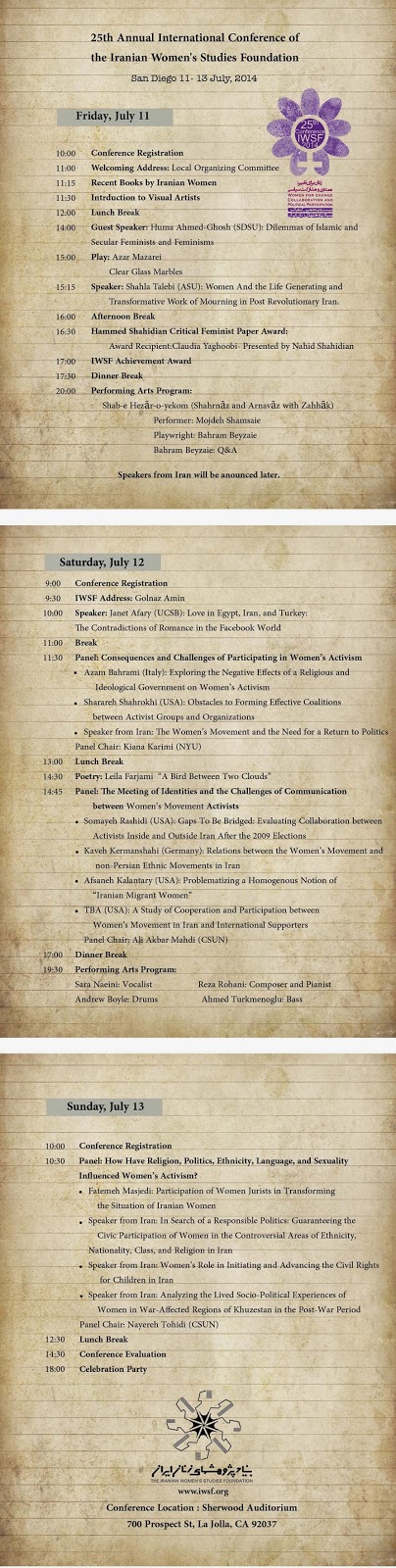
25th Annual Iranian Women’s Studies Foundation (IWSF) IWSF Conference 2014

The 25th Annual Iranian Women’s Studies Foundation (IWSF) Conference will be held on July 11 through 13, 2014 in Sherwood Auditorium. La Jolla. San Deigo

IWSF is a feminist non-profit organization with no affiliation to any political or religious group.

The theme of our IWSF 2014 SoCal Conference is
“Women for Change: Collaboration and Political Participation”

The conference will include paper and poster presentations, workshops, as well as invited talks.

Questions to be addressed:
* How women's experience of gender is shaped by socioeconomic status, language, ethnicity, etc.?
* How women can or should organize for change?
* What role does gender play in leadership?
* What are the opportunities, challenges, and effects of women's political participation?
* What role can the women's movement play in the political arena of Iran?
* What has the role of Iranian women in society and politics been after the revolution? Specifically, what have the impact of their achievements and challenges been?
* Who is responsible for gender equality? How can collaboration within the women's movement increase?
* What is the relationship between the women's movement and other movements? (Labor, ethnic and national, etc.) How can they collaborate?
* How can women contribute to peace and security? How are women impacted by lack of security and peace? What does security mean through a gender sensitive lens?


Please check our website for more info
www.iwsf2014.org


Location:

Sherwood Auditorium
700 Prospect St, La Jolla, CA 92037

Time:
July 11-13 2014

Dr.Nayereh TohidiJanet Afary Kiana Karimi , Kaveh Kermanshahi ,Golnaz Amin, IWSF Conference 2014 , Azar Mazarei ,Leila Farjami , Laila Salartash ,Esha Momeni , Reza Rohani, Sara Naeini ,Bahram Beyzaie ,Huma Ahmed Ghosh , Shahla Taleb , Azam Bahrami,Sharareh Shahrokhi, Somayeh Rashidi ,Afsaneh Kalantari ,Ali Akbar Mahdi, Fatemeh Masjedi , will be presented in
25th Annual International Conference of the Iranian Women’s Studies Foundation (IWSF)

Tuesday, June 17, 2014

Two Kurdish Movies in Hollywood

Two Kurdish Movies in Hollywood

Hollywood will be hosting two Kurdish movies on Women's issue in Northern Iraq in Kurdistan. Êk Momik, Du Momik - One Candle, Two Candles and CHAPLIN OF THE MOUNTAINS at the Lammle Noho 7 and after each film people can getting a chance to ask FilmmakerJano Rosebiani and a couple of the actors  questions. 

Please support independent cinema and a dedicated Kurdish filmmaker by attending on one of these nights. Ticket info: http://laemmle.com/theaters/23/2014-06-25#get-tickets

I will be moderating the Q&A on Wed 25 and my dear friend Simon Almen will be moderator on Sat 28 .

Wish to know more about the films,watch the trailers:

One Candle, Two Candles trailer 

One Candle, Two Candles trailer from Jano Rosebiani on Vimeo.

SYNOPSIS:
Teenage, Viyan is given to the wealthy elderly Haji Hemmo in a forced marraige. When she runs out of the bedroom and climbs a tree, refusing to sleep with him. he looses face and tbecomes the laughing-stock of the town. In return, he punishes her by locking her up in the bedroom. The more he's mocked by the townsfolk, the harder he punishes her.
Meanwhile, a traveling young artist, Botan attempts to liberate her. This leads to Haji Hemmo's resolve to set her on fire.
Two Kurdish Movies in Hollywood 
The Chaplin of the Mountains and One Candle, Two Candles by Mr. Joni Rosebiani will be screened this on June 25th in Laemmle Theaters in Los Angeles.  Some  major news papers such as New York Post and New York Times have written rave reviews . My reviews of the the two films are also forthcoming.
the show times are listed in the Lemmle's Theater calendar. Your support is essential for Mr. Rosebiani's continuing film projects that  essentially chronicle  our lived experiences in diaspora and in the mainland.  

Below please see the links to Evini Films and the Theater's announcement of the two movies.
http://www.evinifilms.com/

"Chaplin of The Mountains" Kurdish film Trailer 


A soul searching  journey into the mountains of Kurdistan by five diverse personalities joined by a single quest .A road movie with deep symbolic and intellectual undertones, fusing various  cultures and perspectives in a humanistic display
San Sebastian film festival


UN Women and Women in ّهمئ sponsored the event.


"Writer and director, Jano Rosebiani, brings a surprising lightness to his material, which is further buoyed by a melodic soundtrack and Jonas Sacks's lovely landscape photography."
                                                                                                               -Jeannette Catsoulis, New York Times, Feb. 20, 2014
"There's a great deal of breathtaking scenery, and Rosebiani blends the travelogue vistas with a sense of what daily existence is like in these villages. There's a simplicity and directness in "Chaplin of the Mountains" that keeps it aloft."
                                                                                                                -Farran Smith Nehme, New York Post, Feb. 20, 2014
"To this viewer, what makes it most memorable is the portrait of ordinary Kurdish people shot on location in a remote but beautiful region. They are the real stars. Most of all, you will be mesmerized by a series of performances by Kurdish folk musicians and dancers who are celebrating the continuation of an ancient civilization against all odds."
                                                                                                                 -Louis Proyect, NY Critic / Blogger, Feb. 22, 2014
"[Rosebiani] manages to depict the still horrendous conditions faced by the region's women while demonstrating the growing artistic freedom seeping into its milieu."
                                                                                                         -Frank Scheck, The Hollywood Reporter, Feb. 19, 2014
"At times the film will remind you of magical realism. Viyan climbs a tree in a wedding dress to avoid Hemmo's all-too-persistent advances, a scene that will remind you of a Gabriel Garcia Marquez novel."
                                                                                                            -Louis Proyect, NY Critic / Blogger, Feb. 22, 2014
- See more at: http://www.evinifilms.com/reviews.html#sthash.Ke5zFh30.dpuf


Review by Amir Sharifi and Ali Ashouri
Kurdish Diasporic Cinema
The Chaplin of the Mountains and One Candle, Two Candles
Kurdish diasporic cinema, traceable to 1980’s and 1990’s, is vividly invoked in the work of Jano Rosebiani, the Kurdish American film maker. His Chaplin of the Mountains is informed by lived experiences of exile, nostalgia, journeys, border crossings, intergenerational experiences, memories, reflections, linguistic heterogeneity and code switching, intermingling of music, images, nature and culture. Chaplin of the Mountains, an experience in hybridity attempts to find a new expression in form and theme. 
The narrative structure is initially straightforward. Two young American film graduate students set out to explore the reaction of remote Kurdish in Northern Iraq to the projected screening of universal marvels and magic of Chaplin’s silent films. David ( Zack Gold) and  Alan,( Bennet Viso)  assume that bringing Chaplin to spectators of  remote Kurdish villagers may evoke entirely visceral responses  based on their naïve and implausible premise that cinema had not yet reached the far reaches of this old world. As they are working out the details of their journey with the assistance of their Kurdish guide, Gelali (Kurdo Galali), they meet Naze (Estelle Bajou), a young French Kurdish woman who has given up her search for locating her mother’s ancestral village destroyed during the Anfal genocidal campaign. Naze joins up with the two students, one of whom is also half Kurdish like herself on their cinematic exploration. An ambitious female journalist, Shireen, (Tales Farzan) who is in quest of her career story also joins them as the initial uneasy feelings and uncertainty among them give in to inner connections, affinity, and even romantic intimacy between the characters whose acting is sincere and compelling. Chaplin’s screening while delightful for children is never completely shown as the mute images are interrupted repeatedly with intrusive images and sound such as a shepherd’s brawl and  his bleating goats , the stern objection of a Yazidi priest who considers the projection on the walls of his holy shrine a sacrilege, and songs and dances of a wedding. A nostalgic song in the wedding carries Naze back to her childhood memory of her mother’s favorite song; overcome with emotions she divulges the harrowing life and tragic death of her mother, who had been abdudcted and sold into a brothel in Egypt, but saved and taken to France by Naze’s father. The story line suddenly changes direction as David and Alan and the others commit themselves to helping Naze find her mother’s village. The narratives told by the characters intersect with a turbulent and repressive history and the genesis of hybrid identities and contemporary political changes as experienced by second generation Kurds.  The Chaplin of the Mountains provides some splendid glimpses of Kurdish landscape, vibrant rhythm of melancholic music, and aspects of life from the perspective of an exiled film maker. The melancholic music is spellbinding. The cinematography of some scenes is astounding and the landscape is brilliant as is some of the acting. The long search finally brings them to the village where Naze’s mother had lived before she was abducted and sold. The village situated between Iran, Iraq, and Turkey, a mined area notoriously called Bermuda Triangle for its dangers. Naze and her companions find their way to the village where Naze finds her grandfather, the only resident of the ruined village,   a hermit still traumatized by the destruction, massacre, and violence that had been inflicted on the villagers and his family. The final sequence shows the newly found bond between a grandfather and his granddaughter as the film maker’s optimism bridges the gap between intentions and accidents, generations, languages, the imagined and the real land, and the diasporic world and homeland; in short, the film despite some dramatic and technical idiosyncrasies, upholds the hope for beauty and humanity in the face of tyranny, adversity, and the tragic history of the land and the fragmented existence of its people.

Opens June 25, 2014 at Laemmle Theaters –Los Angeles
Cast: Estelle Bajou, Zack Gold, Benner Visso, Kurdo Galali, Taies Farzan, Enwer Shekhani
Director-screenwriter-producer-editor: Jano Rosebiani
Director of photography: Jonas Sacks
Composers: Ciwan Haco, Agire Jiyan, Rodja, Mehmet Atli, Semir Ali

One Candle, Two Candles 
One Candle, Two Candles, a visually outstanding film by Rosebiani explores the universal problem of forced marriage, particularly child betrothals in a Kurdish town. The story is told through a melodrama. A young 15 year old girl, Viyan (Katin Ender) falls victim to the barbaric tradition of forced marriage. Her pusillaminous, sycophant and greedy father lured by a rich dowry promised by a wealthy local businessman, Haji Hemmo (Enwer Shekhani), forces his young daughter to marry the polygamous man who is old enough to be her grandfather. The defenseless child bride defies such an injustice. On the eve of the wedding she flees the bridal chamber and in desperation climbs a tree from which she adamantly refuses to come down, causing great embarrassment for the much revered Haji, who becomes laughingstock of the townsfolk, including the town’s buffoon.  The increasingly disgruntled and wrathful Haji becomes more abusive, resorting to brutal beatings and raping of the underage girl.  He goes so far to attempt to set her on fire in a fireplace, not realizing that Viyan had managed to crawl out and subsequently helped by Haji’s two other wives. A number of characters, most of whom play their assigned roles well, create a seemingly jocular context for the melodrama: Botan (Perwer Tariq), a travelling artist who falls in love with Viyan, a sphephard who prays to God for a new pair of shoes, a hunchback flasher, Dino, the village buffoon, and most notably, the ubiquitous Kitan (Mina Ibrahimzadeh) known and feared by boys as the “Ball Buster” for the type of death she had inflicted on her violent husband. The power and magic of love prevails in the end as Viyan, despite many ordeals, succeeds in eloping with Botan. Kitan finds her way into the Haji’s house; his shrill cries reecho through the hillside while Viyan, Botan and some other townsfolk are dancing on a bridge right before the two lovers elope on a motor cycle. The film despite its occasionally misplaced humor, succeeds in warning the Kurdish society against the agony and atrocity that young girls are subjected to; many are not are not as lucky as Viyan was to escape their tormenting lives.
However, Rosebiani’s recent movies for Kurds are sincere attempts to convey insightful messages about Kurdishness, Kurdistan and its tragic history, its glorious beauty, and its cultural practices.
Opens June 25, 2014 at Laemmle Theaters –Los Angeles
Cast: Enwer Shekhani, Katrin Ender, Hisen Hesen, Kurdo Galali, Mina Ibrahimzadeh, Gulbahar Kavcu, Perwer Tariq
Director/screenwriter/producer/editor: Jano Rosebiani
Director of photography: Hamid Ghavami
Composer: Alain Pierre

Mr.Jano Rosebiani,and Soraya fallah during Kurdish Community of Southern California's event for screening one of his film

Monday, June 09, 2014

Soraya Fallah Interviews Dr.David Kazzaz-short documentary

http://youtu.be/h9vJlpL7_EA
short documentary


Soraya Fallah Interviews Dr.David Kazzaz
In May 2014 Soraya Fallah ,Women human rights activist and researcher traveled to Denver to revisit Doctor Kazzaz and interview him on his philosophy and activities for peace in the Middle East.

Dr.Kazzaz advocates the WOMEN LEADING LIFE movement and provides a set of life-affirming strategies that can be implemented among any segment of a population, in any nation on earth. Above all, in these deeply troubling times, this treatise offers a message of hope and inspiration and urges us all to cherish and celebrate life.
Psychiatrist and author of Mother of the Pound doctor David Kazzaz, a native of Iraq, pursued his medical studies in Beirut in the 1940s and emigrated to the United States in 1954, settling in Denver, Colorado. He was Senior Associate at the Institute for the Study of Israel in the Middle East in the Josef Korbel School of International Studies at the University of Denver. His life experiences extend from the post--World War one period through the post September 11 era.
Hshores.http://youtu.be/h9vJlpL7_EA

Thursday, May 29, 2014

Stop killing in the name of honor !! Seeking Justice for Donya

Seek justice for Donya !

 By SORAYA FALLAH

 May 2014

A  brutal killing of Donya,a 15 years old child  who forced marriage twice reported as an honor killing case. A few years ago when I was talking about so called” honor killing”, even activists could not understand the issue. Today so many things changed. But still I received some question thus I am going to explain a few points that might be helpful to know more about it.

"Honor killing" generally refers to acts of violence, usually murder, committed by family members or acquaintances of a woman who has allegedly brought dishonor upon her family.

A woman can be targeted by individuals within her family or her tribe, village and kinsmen for a variety of reasons, including but not limited to: refusing to enter into an  arranged marriage, being the victim of sexual assault, seeking a divorce - even from an abusive husband - or (allegedly) committing adultery. The mere perception that a woman has behaved in a way that "dishonors" her family is sufficient to trigger an attack on her life. 

Honor crimes happen more often in transitional systems, such as regions facing war, revolution, globalization or political changes. Rape is often used as a weapon of war, subjecting women to both the threat of dishonor and the brutality of sexual exploitation. Women are violated by both the authorities and their own families, especially in Islamic countries or cultures that have been dominated by Islam. In these cultures, shame takes on a more dominant role.

Women are killed for simply being in love, having an "illegitimate" relationship with someone or being suspected of having a relationship. Women's emotions and sexuality are directly linked to shame in these cultures, resulting in the need for retaliation by the dominant powers.

It is true that Kurdistan Regional Government (KRG) officials are trying to understand and stop a rise in honor killings. The Kurdish government has overturned Iraqi laws that allow relatives to kill women who were perceived to have dishonored their families, but enough action has never been done.

It is crucial that the KRG legally protects women and their right to life. The Kurdish Parliament must push to implement the law which regards "honor killing" as murder, rather than an excusable case.

Women's organizations around the world must not only encourage regimes and government entities to ban this practice, but force these bodies of law to implement an end to such a horrifying act of violence.

The world must also consider the social, political, cultural and economical situations of these regions, all of which lead to a rise in these acts of violence.

I hope that the public will understand that crime in the name of "honor" or any kind of violence against women cannot remain solely an issue for the families involved; it is a concern of the entire society.

I am also urging women's and human rights organizations to stand up for those women who silently suffer at the hands of those they are supposed to trust the most.


There are so much that has to be done. today my fellow activist Arayish Barzanji Director of Public Relations and Media atRwanga Charity Organization wrote me that so many young men were involved in the event :
"Candelight Vigil for Donya at Shanadar Park. 
Everyone who participated came with a heart filled with grief for this poor girl, sending their prayers for her innocence and lighting candles to light her path...God bless Donya and all the girls before her who were killed brutally,,,may we never see this happen again."


Stop Honor Killing.Honor Killing is not our Culture. There is no honor in Killing

Sign the petition
http://www.gopetition.com/petitions/donyas-law.html

Donya's Law

Petition published by Arayish Barzinjee on May 31, 2014
1049 Signatures 
Target: Kurdis
Region: Iraq

Petition Background (Preamble):

In Kurdistan of Iraq, amidst all the growth in the economy and infrastructure, one very important issue which has been fatally neglected in our society is that of violence against females of all ages under the justification of honor. In 2012, 89 women were killed and another 357 were severely burned or mutilated in the Kurdistan Region of Iraq.

Girls under the age of 18, in particular, have been subjected to extremely brutal treatment.

Too many minors have been forced into marriage to become a child bride with no means to escape their fate. Too many have been muted by family members or spouses when trying to voice their objection. Time and time again, this has ended in the murder of our girls, whether by their families or by their spouse.
It’s time to put an end to this horror.

Laws have been created to penalize and punish the criminals “after the fact”, but not enough laws to prevent such heinous crimes from occurring before it can even start.

We need a law that will prevent parents from forcing their daughters into marriage before the age of 18 and religious leaders from having the right to perform marriages of minors under 18 as well. This should be punishable by the courts for both parties.

Petition:

We, the undersigned, insist, that by the end of 2014, the Kurdistan Regional Government, pass Donya’s Law making it illegal and punishable by law, any parent, sibling or extended family as well as any and all religious leaders to force and perform the unlawful and forced marriage of any minor female under 18 years of age.

The Donya's Law petition to Kurdis was written by Arayish Barzinjee and is in the category Gender Rights and Issues at GoPetition. Contact author herePetition tags: 

Wednesday, May 14, 2014

@UNwomenLA Chapter -US Committee -WOMEN, ART AND SOCIAL JUSTICE panel


On Wed May 14 I was honored to moderate a panel discussion for UN Women-US Committee-Greater LA chapter.
Fadia Afashe and Amy Logan were in the panel and Cathy Hilman president of the chapter was MC. It was very great productive panel and engagement of audience. 


Friday, May 09, 2014

End of the war day May 8 and my hope to end war in Earth

Today we celebrated End of the WWII along with Russian who were heroes in the war against war
We should remember these days to know how horrible war is:
We honored all who lost their life.
We all wear wight to support peace


http://en.wikipedia.org/wiki/Victory_in_Europe_Day

Victory in Europe Day


Final positions of the Allied armies, May 1945.
US military policemen read about the German surrender in the newspaper Stars and Stripes.

UK remembers the 50th anniversary in 1995 with a Lancaster bomber dropping poppies in front of Buckingham Palace
Victory in Europe Day, generally known as V-E Day,VE Day, or simply V Day was the public holiday celebrated on 8 May 1945 (7 May in Commonwealth realms) to mark the formal acceptance by the Allies of World War II of Nazi Germany's unconditional surrender of its armed forces.[1] It thus marked the end of World War II in Europe.
On 30 April, Adolf Hitler, the Nazi leader, committed suicide during the Battle of Berlin. Germany's surrender, therefore, was authorized by his successor, Reichspräsident Karl Dönitz. The administration headed by Dönitz was known as the Flensburg government. The act of military surrender was signed on 7 May in Reims, France and on 8 May in Berlin, Germany.

Wednesday, May 07, 2014

In memory of Shekh Taleb

This week we lost a valuable and cheerful member of our community
“Shekh Taleb” 
These are moments when we cannot summon any words to fill in the void that is so suddenly created in our hearts by the loss of someone so dear. My family and I wish that we could show you in some way the depth of our deep sense of solidarity and sympathy. I can only let you know that I feel your deep sadness and he will be greatly missed.
He was  a very well-known member of our communities in San Diego and Los Angeles. Shekh Taleb was a good poet and served the community for more than 30 years. We never forget him.


In an event in San Diego to support of Wan in Kurdistan of Turkey  after earthquake 2011