Wednesday, March 25, 2020

Soraya Fallah new book published

What is better than reading a book? 
There's never been a better time to read a book under quarantine. 
Learning Challenges for Culturally and Linguistically Diverse (CLD) Students With Disabilities
My book published by IGI Global: International Publisher of Information Science and Technology Research.
 I share space with two amazing scholars: Dr. Bronte Reynolds , and Dr. Wendy Murawski

Date of release: week of Spring started 3/16/2020
Dr. Soraya Fallah, with two amazing coauthors, mentors, professors, and friends.


 This book is dedicated to all the children with disabilities from Culturally and Linguistically Diverse (CLD) families who, through no fault of their own, are often marginalized and disenfranchised. It is for children who did not choose to be torn apart by war, displacement, or trauma, and who need our attention now more than ever. It is for all the children who, instead of sitting in classrooms, are in refugee camps. It is also dedicated to the people who instilled a life-long passion for learning and teaching in us. We share this with all who seek equity and equality in education


Why this book is important?
Learning Challenges for Culturally and Linguistically Diverse (CLD) Students With Disabilities is an essential reference publication that identifies ways in which CLD families can be involved with schools to help build educators’ cultural competence and explores the idea of disabilities as a social model with a focus on strengths rather than a medical model focused on needs and weaknesses. Featuring coverage on a wide range of topics including racial identity, leadership wisdom, and family-school collaboration, this book is ideally designed for educators, principals, administrators, curriculum developers, instructional designers, policymakers, advocates, researchers, academicians, and students.


Link to the book on IGI publisher

https://www.igi-global.com/book/learning-challenges-culturally-linguistically-diverse/235422

About the authors:


 The following please read her critique. Unless you want to interview her on phone instead.

There's never been a better time than under quarantine to read a book.

You can access the webpage and book cover below:


Additionally, to ensure this publication is an affordable resource for you, your colleagues, and students, we are happy to provide an exclusive 40% contributor discount on this book and any other publication available on IGI Global’s Online Bookstore. Simply utilize the coupon code IGI40 during the checkout process to take advantage of this offer. Note: This discount can only be used when ordering directly through www.igi-global.com. It is also available on Amazon and Barnes and Noble.


Maybe publishing a book while you cant present it to different places is hard, but does not make it less valuable. 

Even if you don’t need it or don’t buy it, so much about the book is available including the abstracts (for each chapter), Full PDF Dedication, Table of Contents, Foreword(by Dr. Shartriya Collier), Preface, Acknowledgement, and much more to be able to review this book on Amazon, IGI, or on social media platform. It is appreciated however, there is not obligation.


The book is also 


Thursday, November 14, 2019

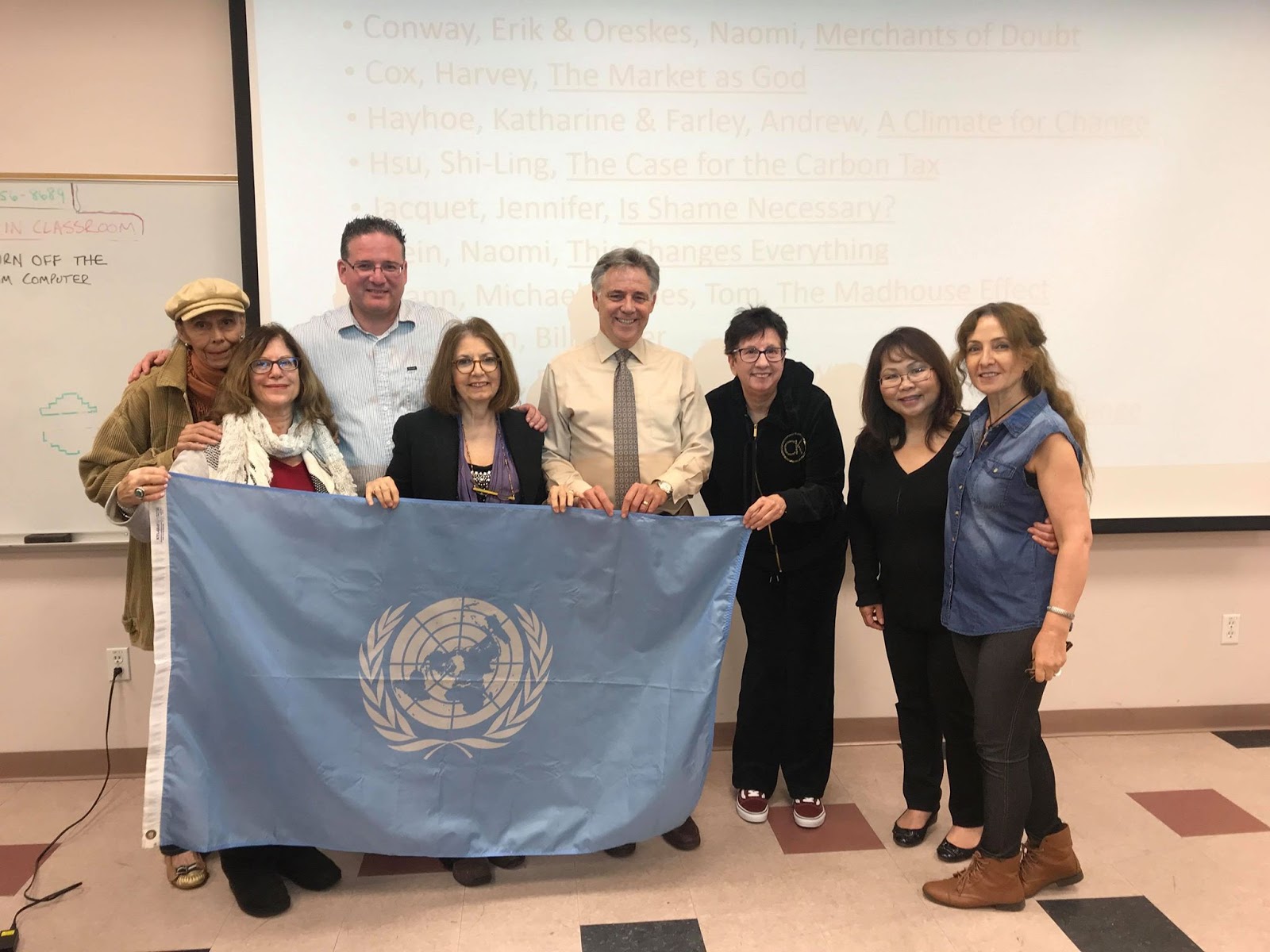
Dr. Soraya Fallah introduces "The Climate Crisis -United nation Day" by UNAUSA SFV


In partnership with the Sierra Club/Los Angeles Chapter, Citizens’ Climate Lobby the United Nations Association San Fernando Valley Chapter hosts the 2019 UN Day Celebration recognizing Our Planet: Our Future
The Rev. Dr. Richard Lyon, psychotherapist, Presbyterian minister & Citizen's Climate Lobby member will to speak on:
The Climate Crisis Now!
Perils and Prospects

This presentation will focus on the current findings of climate science, the answers to questions typically raised by Doubters and Deniers, and a proposed solution contained in House Res. 763: the Carbon Fee and Dividend.

Thursday Nov 7th, 2019 ; 7:00 to 9:00 PM
LAFD Fire Station--89 Community Center7063 Laurel Canyon
North Hollywood, CA 91605
Light Refreshments
Home                       Logo_for_Citizens_Climate_Lobby_2015
                                                   

Sunday, September 15, 2019

UNWomen-LA chapter Annual Assembly from Newsletter

Date: Monday July 22
Time: 7:30-8:30 p.m.
Place: Meet in front of Bibibop Asian Grill
           1401 3rd Street Promenade
           Santa Monica, CA 90401
https://mailchi.mp/ba70e2f674f9/unwomenla-may-newsletter-2464173?e=ed2f2c479b

PAST EVENTS

2019 ANNUAL ASSEMBLY

BELONGING & DISPLACEMENT: UNITING HEADS, HEARTS, AND HANDS
Dear Members and Friends,

Safe Cities LA (SCLA) brings the global work of UN Women home to Los Angeles. It is our local initiative to further all women’s direct participation in creating inclusive and equitable cities. SCLA was launched in 2014 at our second annual assembly. Below are some of our Safe Cities LA projects since 2014;  
Annual Assembly 2014: Safe Cities LA
SCLA Safety Walks + Toolkit (2014-ongoing)
SCLA Safety Metro Rides + Toolkit (2014-ongoing)
SCLA Transit Forum (2015-ongoing)
SCLA Twitter Chats (2016-ongoing)
SCLA Forum: Gender Parity and the LA Experience (2017)
SC Self-Defense Workshops (2017-ongoing)
SC Women and Mobility Survey (2018)
SC Transit + Design Thinking Workshop (2018)
SCLA Forum: The Transgender Urban Experience (2019)

At this year's Safe Cities L.A. 2019 Annual Assembly; Displacement and Belonging; Uniting Heads, Hearts, and Hands over 300 people gathered to collect the stories and wisdom of strong and inspired change-makers who have made passionate commitments to counter division in their communities.

Displacement is half of this year's theme. Why Displacement? Because while we recognize that the experiences of being a refugee, an immigrant and a person living without housing are distinct, displacement as an experience is connected in that it is constructed through division - through the process of othering i.e. patriarchy. Displacement is happening at our border. It is experienced inside our homes and felt inside our bodies. It happens in corporations, in schools, in public spaces, and on public streets. We all have experienced displacement. Displacement is endemic. And it has reached a fever pitch under our current president. Hurt people often hurt others. Displacement, when not processed, creates more distance, disconnection, and division - creating a vicious circle. Thankfully this way of being is not a foregone conclusion, especially as we act with agency. 
My own experience of displacement has taught me to be open and empathetic. It is my access point to the displacement suffered by others in the world. Because, if the displacement of all types, at its very core, is the “othering”  and the lack of empathy, then through opening ourselves to empathy, we turn away from the experience of displacement and pivot to belonging; the other half of this year’s theme.

Creating a shared belonging requires us to practice deep empathy and compassion. It necessitates true listening. It compels us to ask the questions “What if, instead of destroying, we restore? Instead of dividing, we include? Instead of displacing, we engage? It asks us to have the courage to be vulnerable as an act of resistance. We are all creative catalysts in the making of a shared experience of belonging. In the same way, that displacement is deliberate; so too must we deliberate in meaningful discussions on belonging and what it means to each of us, with the hope & possibility of co-creating a shared vision of belonging.

I am deeply grateful to the many members and volunteers who worked on the event. Your amazing energy and generous efforts made our 2019 Annual Assembly a memorable experience of belonging for all.
A special thank you to Suhasini Gupta, Safe Cities L.A. Coordinator and the event assistant producer. Suhasini worked tirelessly on our Safe Cities L.A. programming and the Annual Assembly. As a recent UCLA graduate, she has moved on and is currently in Boston striving to fulfil her goals. We wish Suhasini all the best!

Congratulations on a successful event and many thanks to the entire team: Suhasini Gupta, Yao Jin, Kathleen Hernandez, Faiza Riaz, Jessica Gomez, Celeste Frank, Narelle Norris, Tricia Leskiw, Patricia Natalie, Alexandra Korba, Gorkem Hayta, Jennifer St Clair, Kim Tillman, Carla Truax, Matthew Donovan, Melissa Tillman, Dominique Pinon, Heidi Gaudet, Maria Camila Pava, Hannah Jiang, Beth Mathews, Beth Tyson, Niku Kashef, Jennipha Lauren Nielsen, Mame Mbaye, Soraya Fallah, Swati Srivastava, Hareg Assefa, Christina Kflom, Julie Heifetz, Deepa Paral, Sean Hill, Evie Lee, Glenda Turner, Elham Zare, Brooke Scott, Jessica Gomez, Savannah Downey, Sasha Shapiro, Sharon Nat, Brenda Cruz, Jessica Saldana, Amy Ho, Faria Tahir, Su In Lee, Annika Anderson, Elisabeth Tuttass, Rachel Feng, Hanan Al-Malssi, Daniela Xitlaly Sandoval, Isabelle Ortiz-Luis, Maritza Nat, Melissa Oskouie, Marisa Martinez-Rodenbaugh, Jenna Welsh, Ashley Fleming, Sierra Ryanisrael, Ariana Diaz, Miriam Admasu, Juliette Oliver, Angelina Quint, Chloe Levian, Mackenzi Greene, Safa Saleem, Aelita Arshakyan, Paola Lopez, Marisela Lopez, Delilah Ngayan, Savannah Minassian, Ashley Arias, Brianna Angulo, Veronica Mkhsi-Gevorkian, Nayiri Artounians, Christine Almadjian, Taylor Fairless, Deepa Patel.
It was an honor to work with all of you! Here's to future collaborations towards achieving greater belonging in Los Angeles and beyond!
Warmly, Cathy


Saturday, September 07, 2019

UNWomen-LA Belonging and Displacement: Uniting heads, hearts and hands

UNWomen-LA Annual Summit, Belonging and Displacement “Middle Eastern and North African immigrants with disabilities, Othering vs. Inclusion”, June, 2019.
My talk on : Otherness vs.Inclussion,MENA case

Belonging and Displacement: Uniting heads, hearts and hands

By Dr. Amir Sharifi 28/6/2019

An Iraqi family waits by the roadside outside an IDP camp for civilians fleeing Mosul. PHOTO: Spencer Platt/Getty Images
Last week, the Greater Los Angeles Chapter of the United States National Committee for United Nations Women organized an event on the global day of Displacement and Belonging.

It brought together a wide spectrum of attendees:  native-born Americans, first generation immigrants, second generation immigrants, migrants, human rights activists, artists, and city officials, to address the displacement crisis in both Los Angeles with its increasing homelessness, and escalating displacement elsewhere.

The Annual Assembly featured keynote speakers, Kiki Ayers Fadia Afashe, and Kenia Alococer who highlighted issues of homelessness, Syrian conflict and displacement, and gentrification from unique angles.

Ayers once a homeless young girl and now a celebrity, spoke about the power of personal initiative and determination in rising above the unfortunate circumstances.

Afshe, a Syrian artist and women’s rights activist, spoke of the multiple dimensions of the Syrian crisis and how images of the past including her friends’ drowning in “the dark sea” still haunt her. She spoke of why, as a ‘caring citizen of the world’  she wanted to cultivate a sense of belongingness through her engagement with art and activism.

Kenia Alococer, an immigrant and representative of the Poor People’s Campaign, gave an impassioned bilingual (English-Spanish) talk on the root causes of ill-treatment of undocumented immigrants, fear of deportation, and the specter of gentrification, which she attributed to unfettered capitalism.

There were also multiple discussion groups on how and why it was important to build and nurture safe places for people to have a sense of belongingness. These discussion groups, each attended by 15-30 people, addressed issues ranging from public and private physical places to common humanity, heterogeneity, and displacement.

In the 'role of creative art' discussion group, I was reminded of my uncle who left me with an enduring fascination for oral storytelling (the only kind that I came to know, since written Kurdish was forbidden in Iran). This in turn, played a part in informing my scholarly pursuits in Los Angeles, where I now call home.  

In another discussion group, we discussed gentrification as a form of displacement. I brought up the global dimensions of displacement, and the specific case of Kurds as a stateless people, who faced existential threats including displacement and disappearances, mass exodus, and expulsions.

I cited Turkey as an example, and how the Turkish state has sold the “safe zone” as a humanitarian project, when it would also serve as a much needed economic boost through housing projects in areas that have been inhabited by Kurds along its borders. This is the same policy that Hafiz Al-Assad pursued in the 1970’s, in a massive displacement of Kurds, in what has come to be known as the “Arab Belt”.

The event held during the Refugees’ Week, was timely and important as displacement is one of the greatest dilemmas of this century as every other minute someone somewhere in the world is displaced. 

Our world is facing a colossal crisis, violence committed against refugees and internally displaced people that we cannot turn away whether the reason be environmental, political, or cultural.

Displacement has become truly global, exponentially rising from 10 million in 1980 to 71 million in 2019. An issue that the Assembly did not address adequately is the relation between violations of human rights and different forms of displacement; from house evictions to people displaced by violence.

The all-day event culminated in a panel discussion in which the Director of Domestic Violence and Vulnerable Populations at the Los Angeles Mayor’s Office of Public Safety, Chanel Smith, in addition to other human rights activists including Cynthia Buiza, Dr. Soraya Fallah, Alisa Orduna, and Set Hernandez Rongkilyo debated about the underlying causes of bias and ways of building more welcoming and safer spaces for vulnerable populations.

The discussion ranged from being sensitive to social cues in our environment to built-in social structures, concepts, developments, and policy making, all of which have to be revisited and conceptualized as Los Angeles has yet to become both physically, culturally, psychologically a place of comfort and safety for all.

The participants discussed their outlooks and visions for this reconceptualization of Los Angeles as they uncovered various forms of discriminations, particularly against women.

Dr. Soraya Fallah, A Kurdish woman from Iran, a longtime human rights activist, one of the organizers, a founder and former co-president of UNAUSA chapter, as a part of her research, addressed the different types of discriminations that Middle Eastern and North African immigrants, particularly those with disabilities experience.

She stressed the need for a broader education on cultural sensitivity towards the issue of “otherness” and acceptance as practical ways to mitigate and eliminate various forms of discrimination.

There was much more to say about belonging and displacement, but the UN Women’s event did bring “heads: “hearts” and “hands” together. We should acknowledge in particular, Cathy Hillman, the event’s main organizer, and event art curator and master of ceremony Niku Kashef, for their efforts in organizing and coordinating the Safe Cities in L.A.


Dr. Amir Sharifi is director of the Kurdish Human Rights Advocacy Group. 

The views expressed in this article are those of the author and do not necessarily reflect the position of Rudaw.