Tuesday, December 01, 2009

My name is Ms Zeinab Jalalian


Dear Human right organisations

My name is Ms Zeinab Jalalian (زینب جلالیان)

I am 27 years old Kurdish female ,political prisoner, in Iran prison.

My Death sentenced was confirmed by Iranian Supreme Court.

I am currently ill ,because of torture and I don’t have any lawyer to defend me. i want to tell you that . trial took only few minute.

Court told me: “You are a God's enemies. Have to be hanged very soon” That was all my court process

I asked judge to give me permission to say good bye, to my mother and family,

Before execution, he told me "shut up" and rejected.

Zeinab Jalalian (زینب جلالیان)

26/11/2009

Sunday, November 29, 2009

PRESS RELEASE A GLOBAL CELEBERATION OF HUMAN RIGHTS THROUGH ARTS AND CULTURE

PRESS RELEASE

A GLOBAL CELEBRATION OF HUMAN RIGHTS THROUGH ARTS AND CULTURE

IN SOLIDARITY WITH THE CIVIL RIGHTS MOVEMENT IN IRAN

The United Nations’ International Human Rights Day

For Information: Ali Reza (310) 458-3936, Soraya: (310) 990-1696


For Immediate Release

LOS ANGELES: On Saturday December 12th, 2009, United4Iran-SoCal[1], an umbrella coalition dedicated to human rights and democracy will host an event “Arts United 4 Iran” in conjunction with Amnesty International and other organizations from 1:00 P.M.-8:00 P.M. at the Santa Monica Civic Auditorium.

Artists from around the world will come together in solidarity with the Iranian people's struggle for human rights and democracy. The day will be filled with music, visual arts & performing arts not only to highlight the violations of human rights and specifically institutional violence and discrimination against women, but also to bring awareness and celebrate the Civil Rights Movement in Iran.

The event will honor the 61st anniversary of the UN adoption of the Universal Declaration of Human Rights and the U.N. International Human Rights Day (December 10th ). December 12th also marks the six-month anniversary of the June 12Th Presidential election in Iran, which triggered massive peaceful protests that were violently suppressed by the Islamic Republic’s security forces, reports of which have been seen by millions of people all around the world.

Many brave artists in Iran are speaking out demanding human rights and it is up to each and every one of us living in the free world to support them. We ask the public and the media to show their support by attending and covering this event.

Schedule of the program (additional programs will be announced upon confirmation):

MC: Nazanin Boniadi, Amnesty International’s spokesperson, accomplished actress

1:00– 8:00 pm Art Gallery Exhibition by Iranian Visual Artists

2:00 - 3:00 pm. Movie/Documentary by: Rakhshan Banietemad

3:00 – 5:30 pm

Speeches:

Hadi Ghaemi, Coordinator of the International Campaign for Human Rights in Iran;

A member of the One Million Signature Campaign in California;

Hassan Yousefi Eshkevari, Scholar/Thinker of religious renaissance;

Shirindokht Daghighian, Students’ Condition In Iran;

Soraya Fallah, Ethnic and Religion minority issues;

poetry, video clips

5:30 – 7:30 pm Music: Selective members of Shams Ensemble; Azad Hip hop artist & more

7.30. – 8:00 P.M Film Lion Women

[1] United4Iran-SoCal, is a non-partisan coalition of Southern California Organizations, individuals and groups who stand in solidarity with the people of Iran in their struggle for democracy and human rights.

Sponsors: Amnesty International

Society for Human Rights in Iran (Southern California)

One Million Signature Campaign in California

Society for Democracy in Iran


Thursday, November 19, 2009

My beloved Mother in-Law past away

A memorial service to remember & celebrate the life of Mrs.Aysheh Khatooni, Mr. Azad's loving mother چاپ ارسال به دوست
Cklara Moradian

dayeh-aysheh-1989.jpgDearest Friends and Colleagues,

With a heavy heart and tearful eyes, I must let you know that on November 14, 2009 my family and I were given the sad news that my beautiful and sweet grandmother, Ayesheh Khatoony left this world.

Hajieh Ayesheh Khatoony had not even reached the age of retirement at the time of her passing in the city of Saghez, Kurdistan, Iran, but a life of dedication to her family and people, Kurdish suffering, childbearing, mourning and grief had taken its toll on her tender heart.

Her surviving children Nader, Hasiba, Nasrin, Fahima, and my father Azad Moradian will miss her terribly and keep the memory of her gentle face alive. Daya Ayesheh, as I called her, was always ready to feed, nourish, heal and comfort the people around her and often sacrificed herself to protect her loved ones. Her compassion and altruism were beyond measure, and this came as no surprise, because she was from a family with a long history of justice seekers. She lost many of her close relatives in the fight for freedom and she will now finally join her two dear martyred brothers, the noble Kurdish heroes Yahya and Abbas Khatoony.

Despite nearly 14 years away from my grandmother, I still remember her warm embrace, the comforting aroma of the dried cloves around her neck, her whispered prayers, and even the taste of her Kurdish cooking.

On Sunday November 22, 2009 our small family will be holding a memorial service to remember and celebrate the life of this wonderful, authentic, and loving mother, woman, grandmother, and honest human being; Hajieh Ayesheh Khatoony.

Please join us for some words, photos, and refreshments between the hours of 4-8pm. Presentation will be at 6pm and refreshments served at 7pm.

Location: The Northridge Village Community Center

8065 Canby Ave
Reseda, CA 91335-1303

Time: Between 4-8pm

Street parking is available by Northridge Hospital on Cantera St. /Reseda Blv.

Contact Info:

Cklara Moradian

Cell: 408-421-9444

cklaramoradian@yahoo.comThis email address is being protected from spam bots, you need Javascript enabled to view it

Tuesday, November 10, 2009

Ehsan Fattahian was executed by the Islamic Republic...

Wednesday, November 11, 2009


I Never Feared Death: The Plight of Ehsan Fattahian

The last glimmers of the dusk sun

Are showing me the path on which to write;

The sounds of leaves under my steps

Are telling me “let yourself fall

And you will rediscover the path to freedom.”

I never feared death. Even now, as I feel its odd and honest presence next to me, I still want to smell its aroma and rediscover it; Death, who has been the most ancient companion of this land. I don’t want to talk about death; I want to question the reasons behind it. Today, when punishment is the answer for those who seek freedom and justice, how can one fear his fate? Those of “us” who have been sentenced to death by “them” are only guilty of seeking an opening to a better and fair world. Are “they” also aware of their deeds?

I started my life in the city of Kermanshah, the name of which has always been on the tongues of my compatriots for its greatness; the city which is called the cradle of civilization. As my thoughts were developing, I came to see and feel the injustice and discrimination; an injustice that targeted me not only as an individual but also as a member of humankind. I went in thousand different directions to find out the reasons behind injustice. Alas, they had made the arena so closed for those who were thriving for justice that I could not find my way in. I immigrated to another arena outside the superficial boundaries to find answers to my questions. I became a Komeleh guerilla in order to find my stolen identity. Yet I never separated from my first home, and once in a while I returned there to renew my memories. And then one day, they found me during one of my visits, arrested me and put me in a cage. The greeting my captors reserved for me from day one convinced me that my fate would be similar to those who had walked before me along that road: torture, fabricated charges, biased court, an unjust and politically motivated verdict and finally death.

Let me put it this way: after being arrested on July 20th, 2008, in Kamyaran, I was taken to the Intelligence Ministry’s local office. A few hours later, as I was blindfolded and chained and could not see or move, a person who introduced himself as the deputy prosecutor began questioning me. His questions were irrelevant and filled with made up accusations (let me remind you that it is strictly against the law to interrogate people in places other than courts and tribunals). This was the first of many interrogation sessions I had to face. The same night, I was taken to the Intelligence Ministry’s provincial headquarters in Sanandaj, where I had to attend the real party: a dirty cell with a disgusting washroom. The blankets had not been washed for years. This was the beginning of three months of going up and down the hall from my cell to the interrogation room, always being beaten along the way. The honorable interrogators were so keen to get a promotion or make a bit more money that they accused me of all kinds of bizarre things, even though they knew of the falsehood of their accusation. They used every means in their power to prove that I had taken part in armed operations. In the end they could only prove that I had been a member of Komeleh and had taken part in propaganda activities against the regime. The 10 year sentence handed by the initial court is good proof that I only had one charge. The 1st branch of the Revolutionary Court in Sanandaj sentenced me to 10 years in prison, to be served in Ramhormoz Prison outside Kordestan. The political and administrative establishment in Iran has always been in favor of centralized policies, but, apparently, in my case, they had decided to reverse course! Recently provincial appeals courts have become the judicial authority to rule in cases related to political prisoners, even in capital punishment cases. Capital punishment cases were the jurisdiction of the Supreme Court. So, the Kamayaran prosecutor objected the initial ruling, and, surprisingly, against Iranian law, the 4th branch of the Kordestan Appeals Court changed the 10 year sentence to a death sentence. According to Article 258 of Iranian Criminal law, appeals courts can only issue a heavier sentence when the initial sentence is lighter than the minimum punishment required by law. The indictment presented by the prosecutor stated the charge as Moharebeh (enmity against God). The minimum punishment required by law in similar cases is 1 year in prison. Now, be the judge yourself and compare the 10 year prison sentence (served in exile) with the minimum required to see how illegal, unlawful and political the death sentence is.

Let me add that, shortly before my sentence was changed to the death sentence, I was taken from Sanandaj prison to the Intelligence Ministry’s detention center, where I was asked to make a false confession on camera, show remorse for the actions I had not committed and reject my beliefs. I did not give in to their illegitimate demands, so I was told that my prison sentence would be changed to the death sentence. They were fast to keep their promise and prove to me how courts always concede to the demands of intelligence and non-judicial authorities. How can one criticize the courts then?

All judges take an oath to remain impartial at all times and in all cases, to rule according to the law and nothing but the law. How many of the judges of this country can say that they have not broken their oath and have remained fair and impartial? In my opinion the number is countable with the fingers on my hand. When the entire justice system in Iran orders arrests, trials, imprisonments and death sentences with the simple hand gesture of an uneducated interrogator, what is to be expected from a few minor judges in a province that has always been discriminated against? Yes, in my view, it is the foundation of the house which is in ruins.

Last time I met in prison with the prosecutor who had issued the initial indictment, he admitted that the ruling was illegal. Yet, for the second time, it has been ruled that my execution should be carried out. It goes without saying that the insistence to carry out the execution at any cost is a result of pressures exercised by political and intelligence groups outside the Judiciary. People who are part of these groups look at the question of life and death of a prisoner only based on their own political and financial interests. They cannot see anything but their own illegitimate objectives, even when it is the question of a person’s right to life - the most basic of all human rights. How pointless is it to expect them to respect international treaties when they don’t even respect their own laws?

Last word: if the rulers and oppressors think that, with my death, the Kurdish question will go away, they are wrong. My death and the deaths of thousands of others like me will not cure the pain; they will only add to the flames of this fire. There is no doubt that every death is the beginning of a new life.

Ehsan Fattahian,

Sanandaj Central Prison

Source: Human Right Activists in Iran

Monday, November 09, 2009

Save Ehasan Fattahian from Execution

Save Ehsan Fattahian from execution
3037 Signatures
Published by Reza Hiwa on Nov 08, 2009
Category: Human Rights
Region: Iran
Target: UN Secretary General Mr Ben Ki-Moon
Background (Preamble):
Excellency Ben Ki-Moon,

The government of Iranian regime is ready to commit one more crime in its desperate behaviour to survive the peaceful freedom movement in the country.

Ehsan Fattahian, the Kurdish political prisoner who went on hunger strike is set to be executed on Wednesday. He is jailed in the Central Prison in Sanadaj.

He was arrested in summer and initially wad condemned to 10 years in prison and exile to a remote prison in the Ramhormoz in Khouzestan, Southern Iran. After the objection the dossier was sent to the Revolutionary Court of Sanadaj, where the sentence was revised and changed to execution! He was accused to be a member of a banned Kurdish political party.

He is set to be executed to set an example of those prisoners who go on strike and don’t stop fighting even within the prisons.

He is set to be executed because the isolated and regime is in panic and kills as many opponents as they can before their end day.

Excellency,
TIME IS RUNNING OUT and every second matters!
Petition:
We ask you to use your authority and do whatever you can to stop this execution. The Iranian regime is behaving as if it were an occupation force.

Please help save Ehsan.

Signatories,

The Save Ehsan Fattahian from execution petition to UN Secretary General Mr Ben Ki-Moon was written by Reza Hiwa and is hosted free of charge at GoPetition.


http://gopetition.com/login.php

Sunday, November 08, 2009

mtvU Poet Laureate: Simin Behbahani


Simin Behbahani

Simin Behbahani
Credit: Behrouz Mehri / AFP / Getty

From a Nobel Prize nomination to inspiring lyrics in rock songs, the 82-year old Simin Behbahani’s work has made a significant impact on the world’s cultural landscape. Behbahani began publishing poetry at the age of 14. With over 15 volumes of published works, her voice reflects a distinct style that defines her work as one-of a kind, spanning topics that explore the depths of political, cultural and moral oppression. Currently one translated volume of her works, entitled, “A Cup of Sin,” is available in the U.S. In addition to the Nobel Prize nomination, Behbahani was also awarded a Human Rights Watch-Hellman/Hammet grant and won the Carl von Ossietzky Medal for her struggle for freedom of expression in Iran, and now she’s mtvU’s Poet Laureate for 2009.

http://www.mtvu.com/shows/mtvu-poet-laureate/simin-behbahani/

Saturday, October 31, 2009

Two Women One Show will feature in the following event By: Cklara Moradian &Soraya Fallah


SJC of Pepperdine University Hosting

The Iranian Art Exhibition.

Social Justic Collaborative ( SJC) of Pepperdine University is an organization of Psychology and M.F.T. Students for Social Change. SJC is proud to host The Contemporary Iranian Art Exhibition in Grand Central Art Gallery, Santa Ana. Time:December 5th. All day event. Panel speakers will start at 5:30 in the theater Where:125 N. Broadway. Santa Ana, CA 92701 Admission in Free. In these crucial Times of Iran's history, this is such a called for event. Let's support theses wonderful Iranian artists in exile. (read less)

Social Justice Collaborative ( SJC) of Pepperdine University is an organization of Psychology and M.F.T. Students for Social Change.

SJC is proud to host The Contemporary Iranian Art Exhibition in Grand Central Art Gallery, Santa Ana .

Time: December 5th. All day event.

Panel speakers will start at 5:30 in the theater

Where: 125 N. Broadway. Santa Ana , CA 92701

Admission in Free.

In these crucial Times of Iran 's history, this is such a called for event. Let's support these wonderful artists as SJC members and fans, Pepperdine University Students,

and ALL advocates for social justice.

Facebook Link:

http://www.facebook.com/group.php?gid=180045960659&v=wall&ref=ts#/group.php?gid=180045960659&v=info&ref=ts

Contact Information:

Annahita Mahdavi Email: annahita.m@gmail.com Cell# 949-246-7557

Chris Hoff Email: choff@2roads.com Cell# 714-767-5861

Wednesday, October 21, 2009

"World's Women For Life"'s report on first mission to Southern Kurdistan on air

This videos are in three parts prepared from an interview with Soraya Fallah president of WWFL.
Mr. Nyma Ardalan in Swana Collection did the interview for KPFK 90.7. This interview is regarding an Internationational conference on Culture of life on Aug 2009 in Southern Kurdistan.


Sunday, October 11, 2009

Mourning Mothers of Human Rights Activists Worldwide


WUNRN
 
Women News Network
 
October 8, 2009

'Mourning Mothers Iran' Stand with Human Rights Activist Mothers Worldwide

Elahe Amani with Lys Anzia – Women News Network – WNN

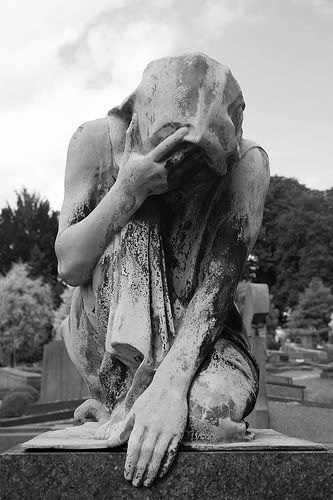
Weeping woman statue. Image: Luc De Leeuw 2009

Weeping woman statue. Image: Luc De Leeuw 2009

A mother protecting her child isn't anything unique. But in Iran, humanitarian activist mothers are now becoming global icons for human rights causes worldwide. In silent public protest, the 'Mourning Mothers of Iran,' known locally in Tehran as the 'Mothers of Laleh,' stand together each week, on Saturday evening vigils in Tehran's Laleh Park.

"I urge all women around the world to show their solidarity with the Committee of Iranian Mothers in Mourning by assembling in parks, in their respective countries, every Saturday between the hours of 7 to 8 p.m., wearing black," said Nobel Peace Prize Laureate, Shirin Ebadi, in a plea made to women and activists worldwide at a July 25 Iran pro-democracy rally in Amsterdam. Like the infamous "Women in Black," and the 'Madres de Plaza de Mayo,' the Committee of Iranian Mothers use methods of ethics in non-violence to bring attention to the atrocity of their dead children.

Beginning in Jerusalem, in 1988, a group of almost 40 Israeli-Jewish women of conscience formed 'The Women in Black.' To make their point, they wore black clothing and stood silent in public protests. They protested against Israeli expansion into the West Bank and Gaza on the heels of the beginning of the 1987 Palestinian intifada. Soon Arab women from the northern region of Israel also joined the Women in Black. The message was asked for "Peace!" Opposing war, injustice, and militarism, Women in Black groups and their affiliates can also be found in Iran, Australia, the UK, Serbia, Japan, South Africa, Italy, Spain, the Netherlands, Belgium, Canada, US, India, Nepal, Uruguay, Argentina and the Philippines, to name a few.

Outside of Jerusalem, 1988 was also a very dark period for Iranian history. In a few summer months, an enormity of crimes against humanity occurred as an overwhelming number of Iranian political prisoners were massacred. This left thousands of Iranian mothers devastated.

According to reports from Amnesty International, 4,500-10,000 Iranian political prisoners were declared killed or missing inside the country that year, over a period that lasted barely two months. After finding out about the death of their loved ones, the families of the victims were not allowed to receive the bodies of their dead. They were also not allowed to hold any funerals. Instead, the held bodies were dumped together in places like Khavaran or what the regime referred to as La'nat-Abad, 'The Damned Place,' a cemetery used for burying non-Muslims.

Mass burials at Khavaran were later accidentally discovered by an Armenian priest who had become curious as to why stray dogs kept digging for bones at, what was later determined the location of the mass graves. French-Iranian woman filmmaker, Mehrnoushe Solouki, was held in Evin Prison for nine months as she, too, stumbled on the discovery in 2007. 

"The deliberate and systematic manner in which these extrajudicial executions took place may constitute a crime against humanity under international law," said Human Rights Watch, in 2005. Perhaps of all the crimes against humanity in the last 30 years, the 1988 Iranian mass executions continue to be the most revealing indication of the regime's contempt and fear of political dissidents.

"In the recent events, the government in Iran has been fabricating reports depicting an incorrect image of what has been going on in the country," said Ebadi at the July 25, 2009 rally. "They do not want the people to know the truth."

We may think this kind of protest is new in Iran, but Iranian mothers have always spoken out against violence, disappearance and the torture of their sons and daughters. Prior to the 1979 revolution, only two mothers' organizations existed in the country. Both were affiliated with underground groups involved in struggles for democracy. They worked in opposition to the monarchy of the Shah's regime, who's policies had turned, at the end, to the jailing and torture of intellectuals, feminists, students, and labour union advocates.

"I need to tell my story. No one can stop me. No one!" said Parvin Fahimi, an active member of Mothers for Peace and the mother of slain 19 year old Iranian protester, Sohrab Arabi, said recently in July. "My son had been killed, but they refused to tell me," she continued.

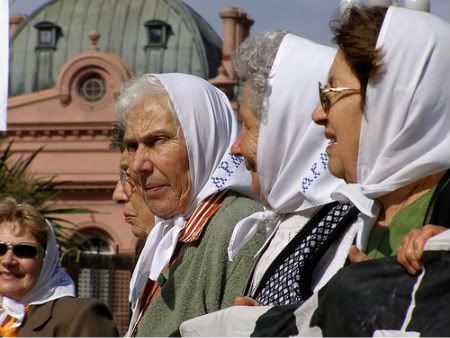
Mothers of Plaza de Mayo

Madres de Plaza de Mayo - Buenos Aires, Argentina, 2008.

On July 11, 2009, young Sohrab Arabi was identified as 'Picture Number 12′ by his older brother at the Shapour Street Police Station in Tehran. He was dead and his family finally knew the truth. He had been missing for 26 days. On the realization, his mother was beside herself with grief.

"Please hear my painful story as a resident of Tehran. I lost my son on Monday 25 of Khordad (15 June) during a peaceful rally that was taking place to protest the election results. With the crowds estimated at a minimum of 3 million, many people were lost and I too lost my son. The mobiles were cut off and I couldn't reach him – I searched everywhere for him and went back home and found he was not there either so I went back to Azadi Square to keep searching for him. The atmosphere was terrible, so much tear gas everywhere, it felt more like a battle ground and I have been sick ever since with chest problems. I couldn't find my child and I returned home and together with the sons of my relatives. As we searched every hospital and police station we didn't get a response. My son did not have his ID card with him; he just had a bit of money on him to go and buy test papers at Enghelab Sqaure to prepare for the university entrance exams coming up…

That night I still did not hear of my son. The next morning when I called 110 (the emergency police call number) they told me to refer to my local police station. I went to the local police station and filed a missing persons report and they started the search process. No one had the guts to tell me than that maybe my son was killed; some people said he was probably arrested and some said he may be injured. I found out that 7 people were killed that day (at the protests) of those, 5 had been identified and 2 had not. The 2 that had not been identified were apparently older. The sons of my family members went to see the 5 that were identified and they confirmed that none of them was Sohrab. I was relieved to hear that and thought that my son was therefore arrested. I knew that he wasn't injured because I searched every single hospital. I am aware that some hospitals would not give me a clear answer, but others did.

So I headed out for the Revolutionary Court (Evin Prison) to follow up on his arrest. They told me to return home and I told them I couldn't – I am a Mother – I couldn't even eat. To this date I have a hard time eating. My throat just closes up. I have kept myself going through liquids only in the past few weeks. I can't tell you how much time I spent at the Revolutionary Court… if I were to write the story it'd make a very thick book. . .

How can a 19 year old that has yet to sit at the University entrance exams, and has yet to fulfill any one of his dreams, be killed? By whom; and on whose orders; and for what? I ask the City Council, what did my son ask of you? What did he ever ask of the government? What did he ask of his country? …We wanted nothing but peace, tranquility and a freedom of thought – that's what's important to us, is that my son thought about whom he voted for and where his vote goes. He didn't ask for anything else. Just because he was a supporter of Mr. Mousavi, he must be killed? For what crime? On the basis of what guilt? My son was in the prime of his youth, a 19 year old, who never fulfilled his dreams. As a mother, I ask God day and night to put an end to this injustice."

- Parvin Fahimi, mother of slain protester, Sohrab Arabi
(Partial testimony given during a Tehran City Council
meeting July 23, 2009)

The exact circumstance surrounding the death of Sohrab Arabi continues to be unexplained. According to the International Campaign for Human Rights Iran, when the family received Arabi's body, his death appeared to be from the result of a gunshot wound to the chest, but no one knows when or where this injury occurred. An official, but inconclusive, report was made by the Coroner on June 19.

The lives of the mothers of missing global activists, who are often called, 'mothers of the disappeared,' are often filled with moments of endurance and courage, in spite of the grief they carry. From the mothers of slain reporters working in Iraqi Kurdistan or the Ukraine; to the mothers of missing activist children in Iran or Argentina; the mothers of those who have who have 'gone missing' have the same experience over and over again. Mothers worldwide have the same fear, grief, anger and frustration about their dead and missing children.

"I begged the gunmen to kill me instead, and they pushed me away and told me that they wanted her not me," said Kurdish mother of slain Iraqi journalist, Sara Abdul-Wahab, during a May 2008 Associated Press interview. In spite of her mother's attempt to save her life, Sarwa was fatally shot twice in the head by kidnappers. Tragically, her mother felt she could do nothing to save her daughter. Sarwa was the only breadwinner for a widowed mother, a sister and brother. She was a strong defender of human rights, a Kurdish lawyer and activist in Iraq, who continued to work in spite of numerous threats against her life.

When Ukrainian Prosecutor, General Mykhaylo Potebenko, issued a statement saying that DNA tests were delayed due to the illness of Lesya Gongadze, the mother of the missing and presumed dead human rights reporter Georgy Gongadze, Leyla grew suspicious. "This is a complete lie and deception," she told Ukrainska Pravda, the Web newspaper that her son founded. "I wasn't that sick, not so much as to be unable to give my blood for analysis. I was even insisting on it because I wanted to know the truth," she added.

For nine year Gongadze case has been rife with confusing facts and government shuffle. Georgy Gogandze's mother, Lesya Gongadze has been struggling to expose the facts from the moment her son went missing. Faced with the dilemma of not trusting the validity of DNA tests made by the Ukrainian authorities for an unidentifiable body that was found in 2000, Lesya continues to ask questions and demand clarity on the true circumstances surrounding the murder of her son. To date, she has not been satisfied with the answers given her.

In Argentina, mothers of missing activists ask the same questions as mothers worldwide. These questions have lasted in Argentina almost 33 years. In 1977, they came together in Buenos Aries calling themselves the 'Madres de Plaze de Mayo (Mothers of the Plaza de Mayo).' Ignoring a law prohibiting more than 3 people from gathering in one place, they began walking the plaza two by two, in the form of heroines under the threat of arrest. They began as 14 mothers who publically protested the disappearance of their children. Their protests began during what has been called the 'Dirty War' of Argentina, a war beginning with the military dictatorship of General Jorge Rafael Videla.

"By the end of the year (1977), thousands would be illegally detained, tortured, assassinated or disappeared," says a now declassified document at the US National Security Archive.

In panic under the sudden disappearances of Argentine labour advocates, students and social activists, the mothers began to speak out strongly to demand answers. A military coup had taken over Argentina with a vengeance, lasting seven long years with what has been counted today as up to 30,000 missing or dead.

In 1978, "A recent dramatic occurrence was the abduction, in December, of five 'mothers of the disappeared' and two French nuns, whose bodies were reportedly discovered washed ashore," continues the declassified US National Security Archive report.

"One of the things that I simply will not do now is shut up. The women of my generation in Latin America have been taught that the man is always in charge and the woman is silent even in the face of injustice… Now I know that we have to speak out about the injustices publicly. If not, we are accomplices. I am going to denounce them publicly without fear. This is what I learned," says Mother of Plaza de Mayo, María del Rosario de Cerruti.

Since 1977, the bereaved mothers have gathered to walk around the Plaza de Mayo in central Buenos Aires for 30 minutes every Thursday afternoon. Wearing white headscarves as a symbol of peace, the simple action of the mothers walking in a circle for peace has finally caught the world's attention. Their movement has inspired families of the disappeared and victims of human rights violations in many parts around the world to engage in similar peaceful protests in public places.

On June 27, the Mothers of Lelah made a formal statement to the world that echoed the grief of all mothers worldwide.

"What crime have they committed to deserve death? Why do we Iranian mothers have to bear this enormous grief? What is our crime? We will never let this crime against us and our children pass by unnoticed. From now until the release of all detained demonstrators, the cessation of violence and until our children's killers receive their punishment, we will every week gather in silent mourning near the place where our beloved martyr Neda died at Park Laleh. We urge all parents who are concerned about their daughters and sons, the future capital of our country to join us."

- The Committee of Mothers Iran (Mourning Mothers of Laleh) 2009

To date, the Argentine mothers have received 3 major international awards for their work with human rights; the Sakharov Prize for Freedom of Thought, the United Nations Prize for Peace Education and the United Nations Prize in the Field of Human Rights. It is expected that the Committee of Mothers Iran (The Mourning Mothers of Laleh) will follow the legacy of Madres de Plaza de Mayo with special award and recognition in their time.

"Holding on to memory is the way to fight the remains of the past regimes who want the whole story of the disappeared to vanish," said Morea, one of the Plaza de Mayo mothers.

"If you want justice and freedom, you have to put everything else on hold," said Iranian mother Parvin Fahimi, recently in a Sept 2009 interview.

_________________________________________________________

Click Website Link & Scroll Down to Video:http://womennewsnetwork.net:80/2009/10/08/mourning-mothers-iran-stand-with-activist-mothers-worldwide/

This subtitled (English) video shows the depth of funeral grief of Parvin Fahimi, the mother of slain 19 year old Iranian protester, Sohrab Arabi, as she speaks out against the murder of her son.
_____________________________________________________________

Click Website Link & Scroll Down to Video:http://womennewsnetwork.net:80/2009/10/08/mourning-mothers-iran-stand-with-activist-mothers-worldwide/

Rock star, Bono, from the infamous band U2, brings the Mothers of Plaza de Mayo on stage during a concert in Santiago, Chile (1998) to address the audience one by one as they share their pleas for justice.
_________________________________________________________


================================================================
To contact the list administrator, or to leave the list, send an email to: wunrn_listserve-request@lists.wunrn.com. Thank you.